HeatSafe — heat-safety readings, by location
A free safety tool that translates heat and humidity into one reading — how your body is coping.
- Live at
- heatsafe.in
- Launched
- Live since 22 Apr 2026; publicly announced 01 May 2026.
- Coverage
- Worldwide · °C (°F for US)
- Cost
- Free. No ads. No tracking.
- Methodology
- Wet-bulb temperature; 32°C operational threshold
- Languages
- English (full), Tamil (UI)
- Contact
- hello@heatsafe.in · 48h response
What HeatSafe is
HeatSafe interprets the temperature and humidity at your location into a single reading: a Heat Safety Index that tells you whether conditions are Manageable, Caution, Danger, or Critical for the human body. It is not a weather app. It is a safety reading — the focused tool that sits alongside the general-purpose ones.
Beyond a certain temperature, your body can no longer cool itself. HeatSafe shows when you are nearing it.
What weather apps don't tell you
Human intuition about heat is built on what we can feel. We feel the sun, we feel a stove, we feel a hot day — external sources of heat are immediate and direct. We do not feel our own internal body heat in the same conscious way. So when we reason about heat, we naturally default to external sources.
That intuition extends to how we think about cooling. The instinctive picture is: when it is hot, the body sweats, and sweating cools us. The physics works differently. It is not sweat that cools the body — it is sweat evaporating. And the energy that drives that evaporation comes from the body itself, not from the surrounding air.
This is why high humidity is dangerous in a way temperature alone cannot explain. When the air is already saturated, sweat doesn't evaporate, and the body's only effective cooling mechanism slows down. The temperature outside may be familiar; the conditions inside the body are not.
HeatSafe has surfaced this intuition gap with five professionals — across aviation, medicine, banking, mental health, and public health — based in India, the United States, and the United Kingdom. In nearly twenty other one-on-one conversations, this gap surfaced at different points: some at the source of heat that drives sweat evaporation, some paused at humidity, some didn't connect sweat evaporation to cooling at all. The gap is cognitive, not cultural — it sits beneath education and profession, in the way human sensing is built.
This is the editorial story. Weather apps report the numbers. Without the interpretation, those numbers don't translate into safety decisions for a body. HeatSafe bridges that gap.
Real-life example: Chennai, October 2024
On 6 October 2024, the Indian Air Force held an air show on Chennai's Marina Beach. By every conventional measure, the morning's weather read normal: temperature in the low 30s°C, humidity high but unremarkable for coastal Tamil Nadu. The wet-bulb reading sat in HeatSafe's Caution zone — short of Danger, but already a signal to limit exposure, especially for vulnerable people. The crowd was on open sand, in full sun, for hours.
Five people died. Around 200 were hospitalised. Weather forecasts and public advisories don't use wet-bulb temperature when issuing warnings. HeatSafe, had it existed, would have read Caution — and could have alerted event organisers and local authorities in advance.
The Air Show illustrates why HeatSafe's zones are deliberately conservative. The wet-bulb did not even reach Danger — but on open sand, in full sun, over hours, cumulative heat load goes beyond what any single-moment reading can convey. October in Chennai is not the month anyone associates with heat danger, and that is precisely the point of having a reading that doesn't depend on intuition.
How HeatSafe works
HeatSafe takes live temperature and humidity from Open-Meteo for any location worldwide and converts them into wet-bulb temperature using the Stull (2011) formula. The wet-bulb reading is mapped onto a four-zone scale informed by the peer-reviewed work of Sherwood & Huber (2010) and Vecellio et al. (2022).
HeatSafe uses 32°C wet-bulb as its operational Danger threshold, more conservative than the 35°C theoretical "survival limit" widely cited in the climate literature. Real-world heat stress is shaped by sun exposure, exertion, age, illness, and pre-existing dehydration — all of which push effective thresholds lower than the laboratory ceiling. HeatSafe's calibration reflects this distinction explicitly.
What HeatSafe is not
- Not a medical device. Readings are guidance, not diagnosis.
- Not a personal risk assessment. Individual factors (age, illness, hydration, exertion) shift personal thresholds in ways a public tool cannot account for.
- Not a replacement for India Meteorological Department (IMD) alerts or local public-health advisories. HeatSafe complements official sources; it does not substitute for them.
Origin
HeatSafe was built by one person in Coimbatore, with AI as technical collaborator. From Coimbatore to Tamil Nadu, to India, and beyond — made for an Indian summer, useful wherever heat and humidity matter. Readings show in °C (°F for US).
The tool is free, carries no advertising, and does not track its users. HeatSafe exists only as a public-good infrastructure — built to help people understand when heat most affects the body.
Visual assets
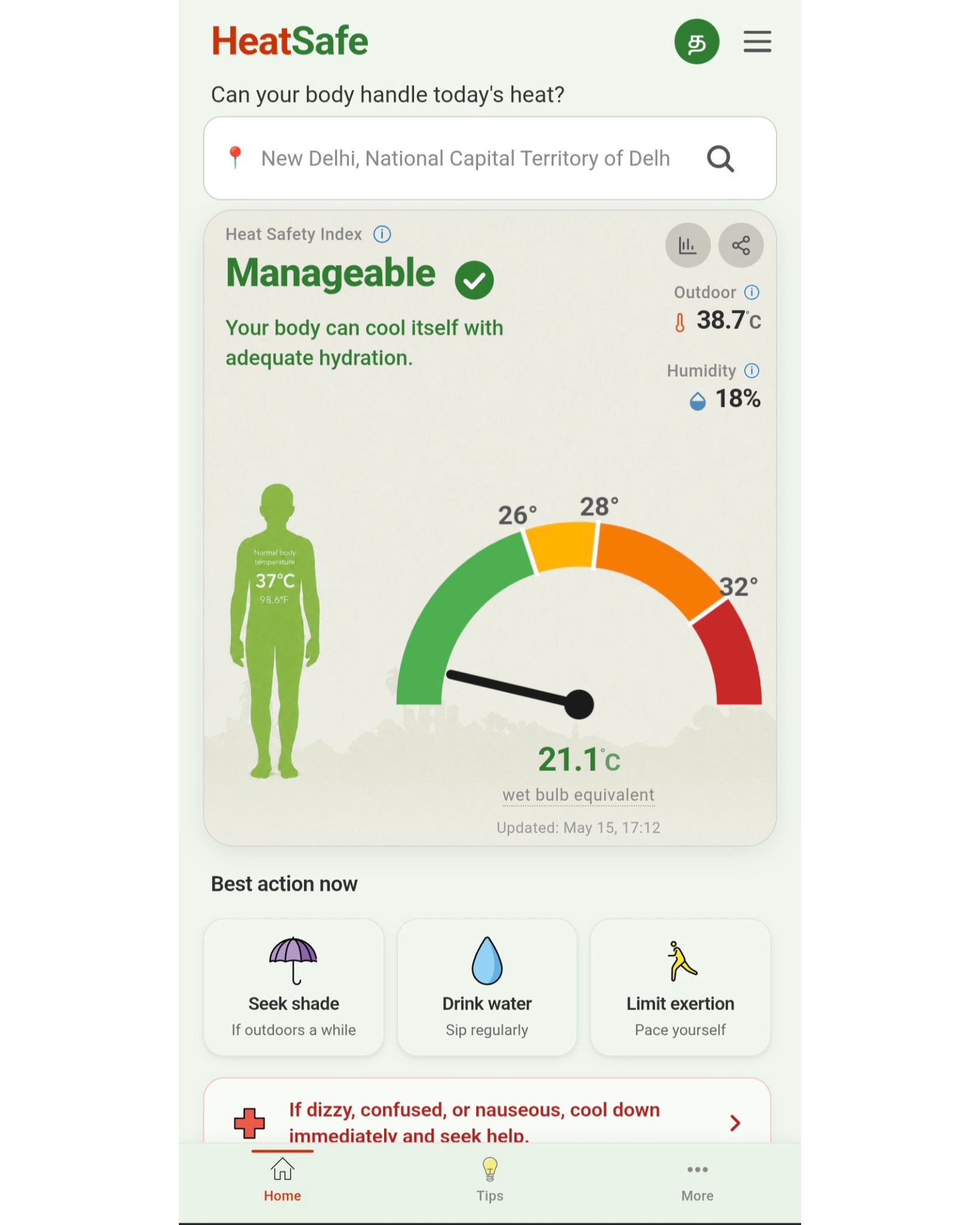
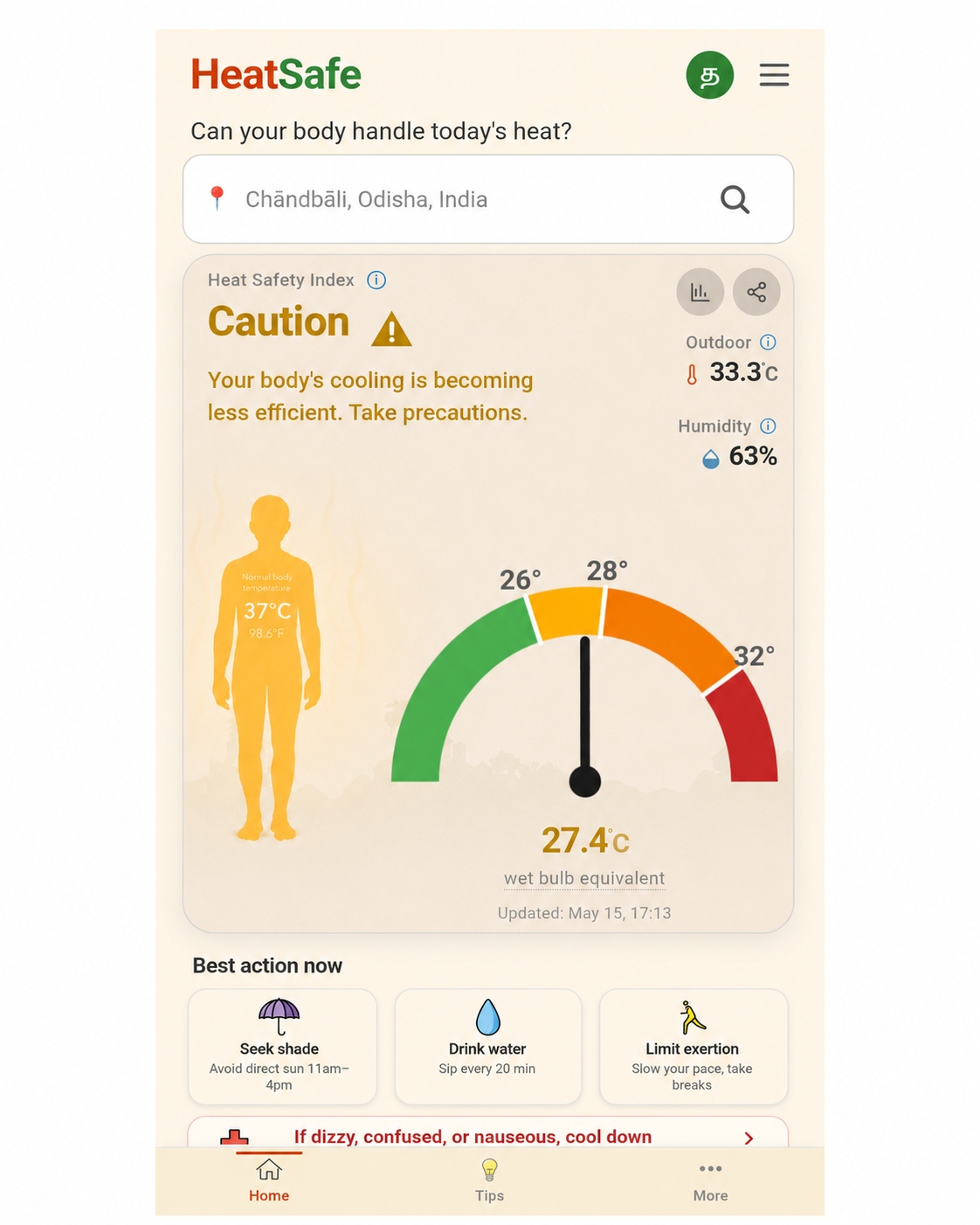
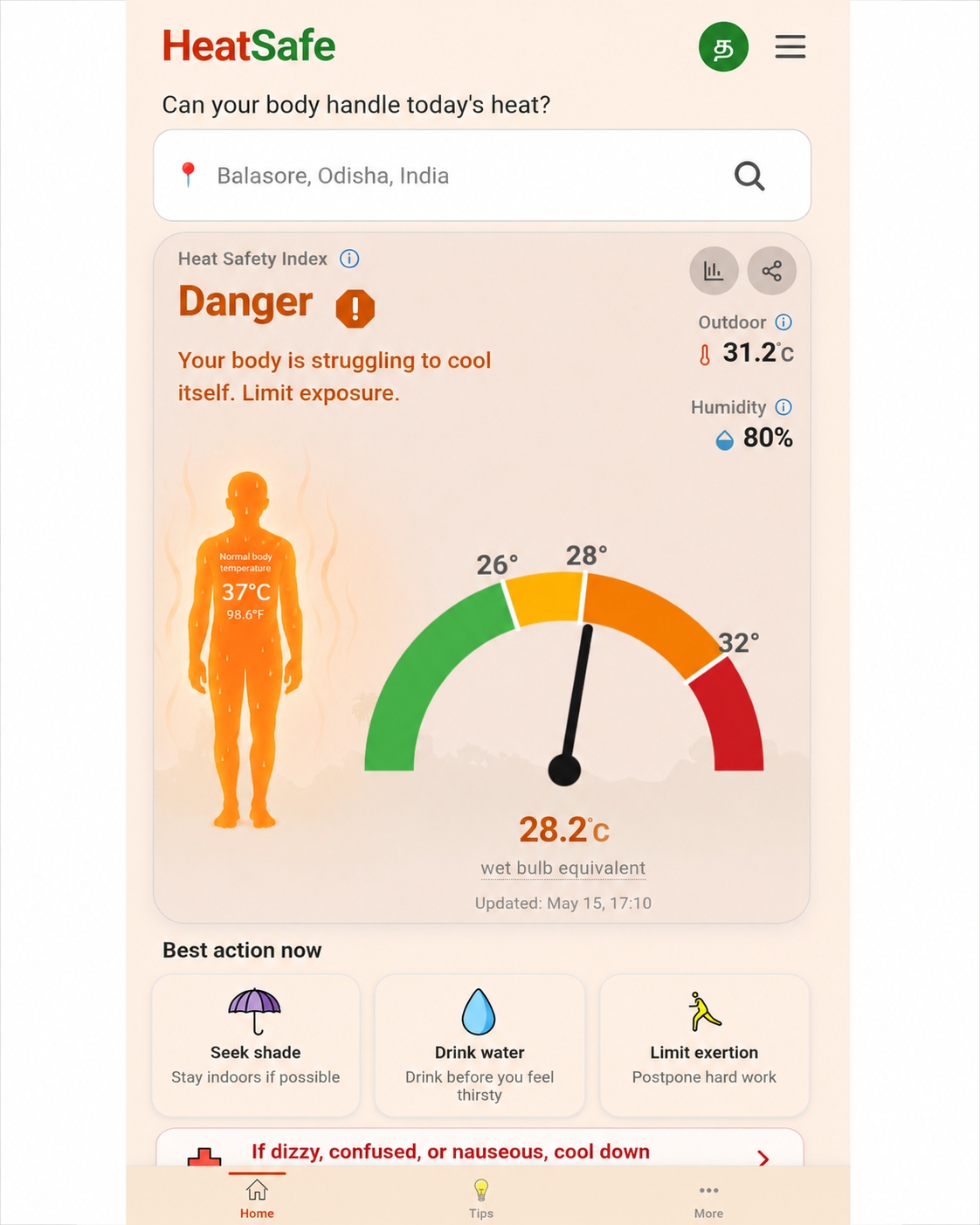
Zones at a glance
Live captures from heatsafe.in showing one location per zone of the Heat Safety Index.
Today's same-hour contrasts
Same time, same tool. How the same — or even a lower — temperature can hide the real heat risk.
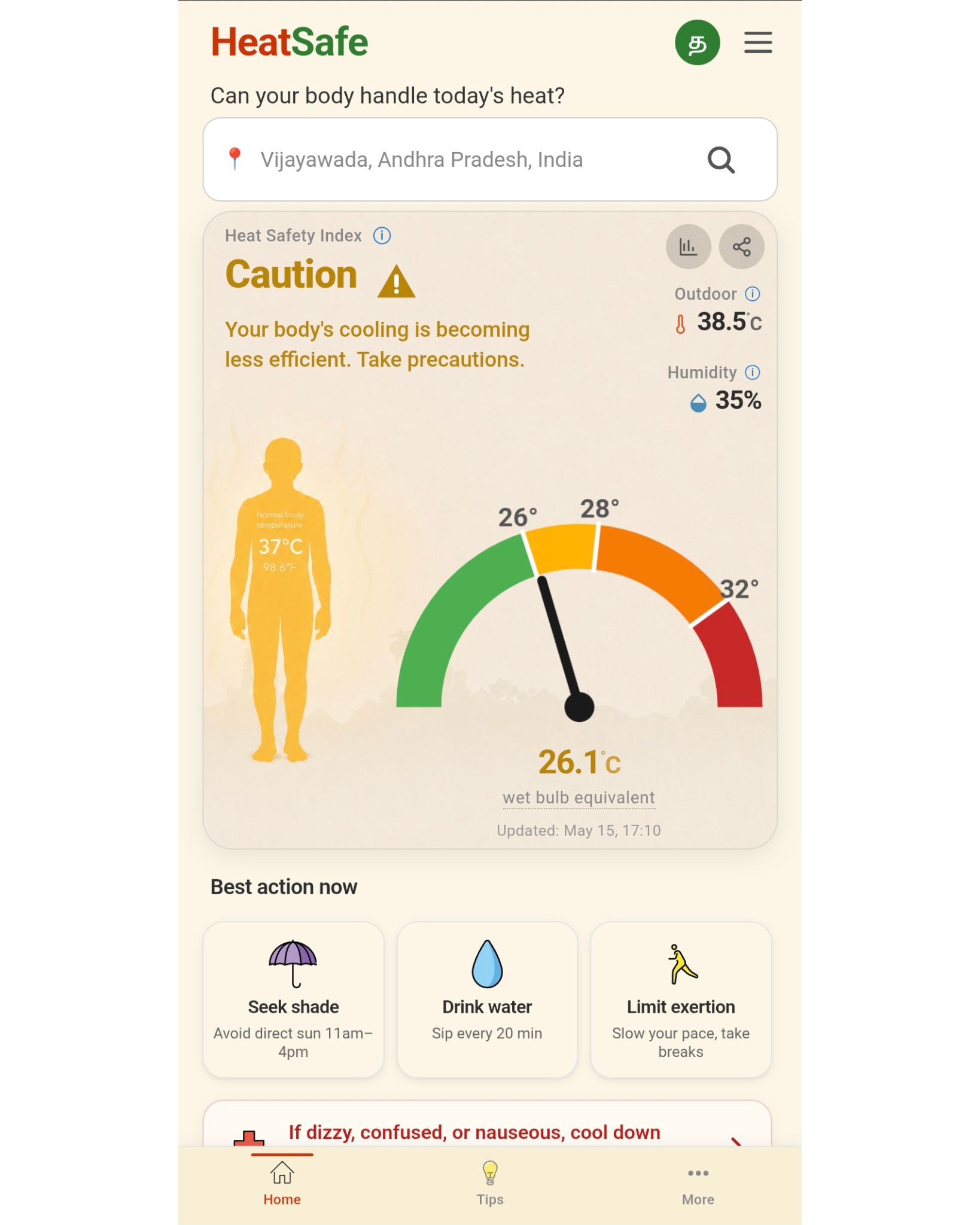
Same outdoor temperature. Different heat danger. The 5°C wet-bulb gap is humidity — and humidity is what your body actually fights.
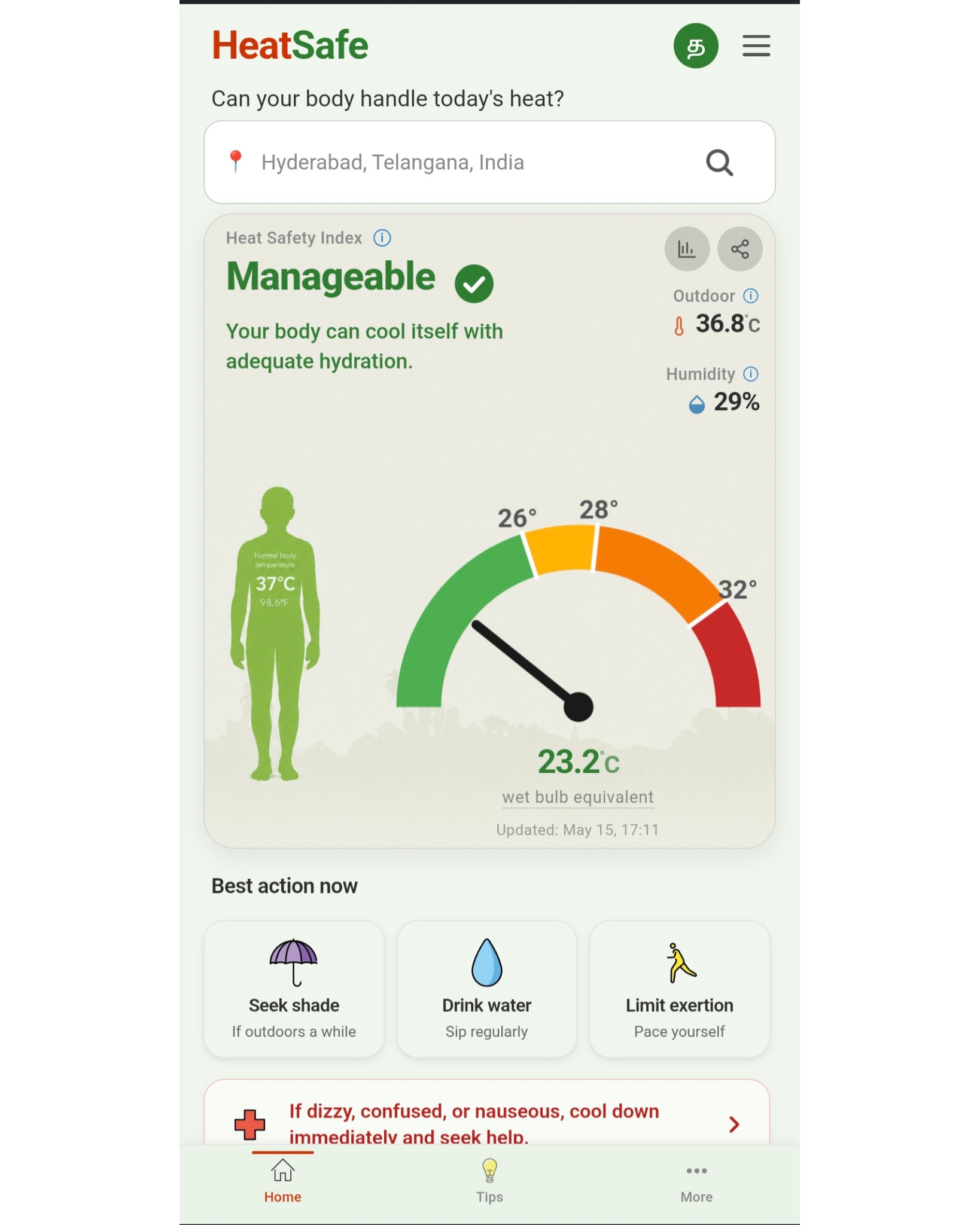
Balasore is 5.6°C cooler than Hyderabad — and in a more dangerous heat zone. Air temperature alone misleads. Wet-bulb is the body's true cooling limit.
Press-friendly lines and links
Copy-pasteable lines by channel
| Channel | Primary | Variant / use |
|---|---|---|
| Press lead | Weather apps tell you the temperature. HeatSafe tells you when it gets dangerous to your body. | A free safety tool that translates heat and humidity into one reading — how your body is coping. |
| Journalist | What weather apps don't tell you: when the heat outside is dangerous to your body. | The Chennai Air Show reading was not even in HeatSafe's "danger" index. Still people lost their lives. |
| FM radio intro | Like AQI, but for heat. Check for your location — free at heatsafe-dot-in. | HeatSafe — the heat-safety reading for your city. |
| FM radio "Stat of the Day" (EN) | HeatSafe reading for [city] today: [Status]. [Action]. | — |
| FM radio (Tamil) | இன்றைய HeatSafe reading [நகரம்]: [Status]. [Action]. | — |
| FM radio (Hindi) | आज की HeatSafe reading [शहर] के लिए: [Status]. [Action]. | — |
| FM radio (Telugu) | ఈ రోజు [నగరం] కోసం HeatSafe reading: [Status]. [Action]. | — |
| FM radio (Kannada) | ಇಂದು [ನಗರ]ದ HeatSafe reading: [Status]. [Action]. | — |
| Fleet managers | Your weather data shows temperature and humidity. HeatSafe shows when conditions cross the body's cooling limit — in real time, anywhere your riders work. | Location-by-location heat-safety readings — input for delivery scheduling, route planning, and rider welfare policy. |
| Share card — generic | Like AQI, but for heat. heatsafe.in | Check your heat safety before stepping out. heatsafe.in |
| Share card — zone | Heat in [city]: [Status]. [Action]. heatsafe.in | e.g. Heat in Chennai: Danger. Take shade and water breaks. heatsafe.in |
| Share card — credibility | Built on peer-reviewed wet-bulb research. heatsafe.in | Conservative thresholds. Open methodology. heatsafe.in |
| GHHIN directory | A free public heat-safety tool that translates wet-bulb research into location-specific, plain-language guidance. Built in India; works globally. | Free heat-safety readings, built on peer-reviewed wet-bulb thresholds. India-born, globally available. |
Direct links to pages a journalist may need
- Methodology
heatsafe.in/methodology.html— formulas, thresholds, citations, Air Show case study - Science
heatsafe.in/science.html— the physics and biology, the intuition gap in detail - FAQ
heatsafe.in/faq.html— common questions, including "why does HeatSafe show 28°C when outside is 38°C?" - Glossary
heatsafe.in/glossary.html— terms defined - About
heatsafe.in/about.html— what HeatSafe is, isn't, and why - Tips
heatsafe.in/tips.html— zone-by-zone action guidance - Feedback
heatsafe.in/feedback.html— contact form
Contact
Email: hello@heatsafe.in
Based in: Coimbatore, Tamil Nadu, India
Response timeframe: Within 48 hours.
For interviews, additional screenshots, methodology questions, or data requests, please write.
Last updated: May 18, 2026